The Power Bill of Artificial Intelligence
Large-scale computing clusters face physical limits as thermal management and grid congestion become primary constraints on the expansion of machine learning infrastructure.
Key points
- Thermal design power for individual accelerator chips now exceeds seven hundred watts, requiring a transition from forced-air cooling to direct-to-chip liquid systems to maintain stable operation.
- Data movement between processors accounts for a significant portion of total energy consumption, as electrical resistance in copper interconnects generates heat that does not contribute to computation.
- Low average utilisation rates in data centres create inefficient energy profiles, where idle hardware consumes a baseline of power without performing useful mathematical operations.
- Electrical grid interconnection queues in major computing hubs are now measured in years, as existing transmission infrastructure lacks the capacity to deliver multi-gigawatt loads to single sites.
The rapid expansion of large-scale computation is no longer constrained primarily by the logic of silicon, but by the physical transport of energy. As data centres evolve to accommodate workloads driven by large language models, the primary engineering challenge has shifted from the speed of the processor to the management of waste heat and the logistical difficulty of providing high-voltage power to a single building. A standard rack of servers, which a decade ago drew perhaps five kilowatts, now frequently requires fifty kilowatts or more. This intensification has forced a reconsideration of the entire electrical and thermal chain, from the substation to the transistor.
Electricity enters these facilities at high voltage, often from a dedicated connection to the national grid. It is stepped down through transformers and converted from alternating to direct current, a process that incurs efficiency losses at every stage. Once inside the server, the power is consumed by billions of microscopic switches. These transistors do not consume energy to perform work in a traditional mechanical sense; instead, they require energy to change their state and maintain it against electrical leakage. Nearly all the energy entering a processor is eventually emitted as heat. In the most advanced artificial intelligence accelerators, this thermal output is now approaching the limits of what solid materials can withstand without structural failure.
The logistical bottleneck extends beyond the walls of the data centre. In many jurisdictions, the time required to approve and construct new grid interconnections has become the primary limit on growth. While a server farm can be built in two years, the high-voltage infrastructure needed to power it may take five or eight. This mismatch has created a queue of projects waiting for power, leading some operators to explore behind-the-meter solutions, such as co-locating data centres with nuclear power plants or installing large-scale natural gas turbines on-site. These measures are attempts to bypass a grid that was never designed for the concentrated, constant load of modern high-performance computing.
The thermodynamics of the modern accelerator
At the heart of an artificial intelligence server is the accelerator, typically a graphics processing unit (GPU) or a custom application-specific integrated circuit (ASIC). The operation of these chips is governed by the principles of CMOS (complementary metal-oxide-semiconductor) scaling. Every time a transistor switches, it must charge or discharge a small capacitor. This process dissipates energy. As chips have grown to include tens of billions of transistors packed into a few square centimetres, the density of this dissipation has reached extreme levels.
The thermal design power of a single high-end accelerator now frequently exceeds 700 watts. When dozens of these units are grouped together to form a cluster, the resulting heat density is comparable to that of a nuclear reactor core, albeit at a smaller scale. If this heat is not removed instantly, the internal temperature of the silicon will rise beyond its operating limit, typically around 100 degrees Celsius. At this point, the chip will either throttle its clock speed to reduce power consumption or undergo a hard shutdown to prevent permanent damage.
Engineers must also contend with the phenomenon of leakage current. As transistors shrink, the insulating layers become so thin that electrons can tunnel through them even when the switch is technically off. This leakage increases with temperature. A warmer chip is less efficient, consuming more power to perform the same task, which in turn creates more heat. This creates a feedback loop that engineers must manage through aggressive thermal regulation. The goal is to maintain a stable, relatively low operating temperature to keep the chip in its most efficient electrical state.
Heat flux and the limits of air cooling
For most of the history of computing, air was a sufficient medium for heat removal. Fans would draw ambient air across heat sinks—finned metal structures that increase the surface area available for exchange—and carry the thermal energy away. However, air is a poor conductor of heat. Its low density and low specific heat capacity mean that a very large volume of air must be moved very quickly to cool a high-power processor. As power densities rise, the physical space required for air ducts and massive fans begins to compete with the space needed for the servers themselves.
The physical limit of air cooling is reached when the volume of air required to cool a rack exceeds the physical capacity of the aisle to deliver it.
Beyond a certain point, increasing the speed of the fans yields diminishing returns. The power consumed by the fans starts to become a significant fraction of the total energy budget, and the noise levels become hazardous to human operators. More importantly, air cooling cannot easily address high heat flux—the amount of heat passing through a specific unit of area. In a modern GPU, the heat is generated in a tiny sliver of silicon, and getting that heat into the air requires a long chain of thermal interfaces, each of which adds resistance. Even with exotic materials like vapor chambers and heat pipes, air cooling struggles to keep the most powerful modern chips below their thermal limits under sustained load.
Energy costs of data movement across silicon
A significant and often overlooked portion of the energy budget in artificial intelligence is not spent on computation, but on communication. Moving data between the processor and its memory, or between different processors in a cluster, requires driving electrical signals across copper traces. This process encounters resistance and capacitance, both of which consume power. In many large-scale models, the "memory wall"—the bottleneck created by the speed and energy cost of retrieving data—is a greater constraint than the raw floating-point performance of the chip.
To mitigate this, manufacturers have moved toward High Bandwidth Memory (HBM). This involves stacking DRAM chips directly on top of or alongside the processor using a silicon interposer, a thin layer of material that allows for thousands of microscopic connections. By shortening the physical distance the data must travel, the energy required per bit moved is significantly reduced. Nevertheless, as models grow to require trillions of parameters, the sheer volume of data being moved across the system remains a massive energy sink.
The energy cost of interconnects extends to the rack level. When thousands of GPUs are linked to act as a single logical computer, they communicate via high-speed optical or copper cables. Converting electrical signals to light for optical transmission, and back again, requires specialized hardware that consumes additional power. In a large cluster, the network interface cards and switches can account for ten to fifteen per cent of the total power draw. Engineers are now researching co-packaged optics, which bring the optical transmitters directly onto the processor package, aiming to eliminate the energy-heavy electrical journey across the circuit board entirely.
The transition to closed-loop liquid systems
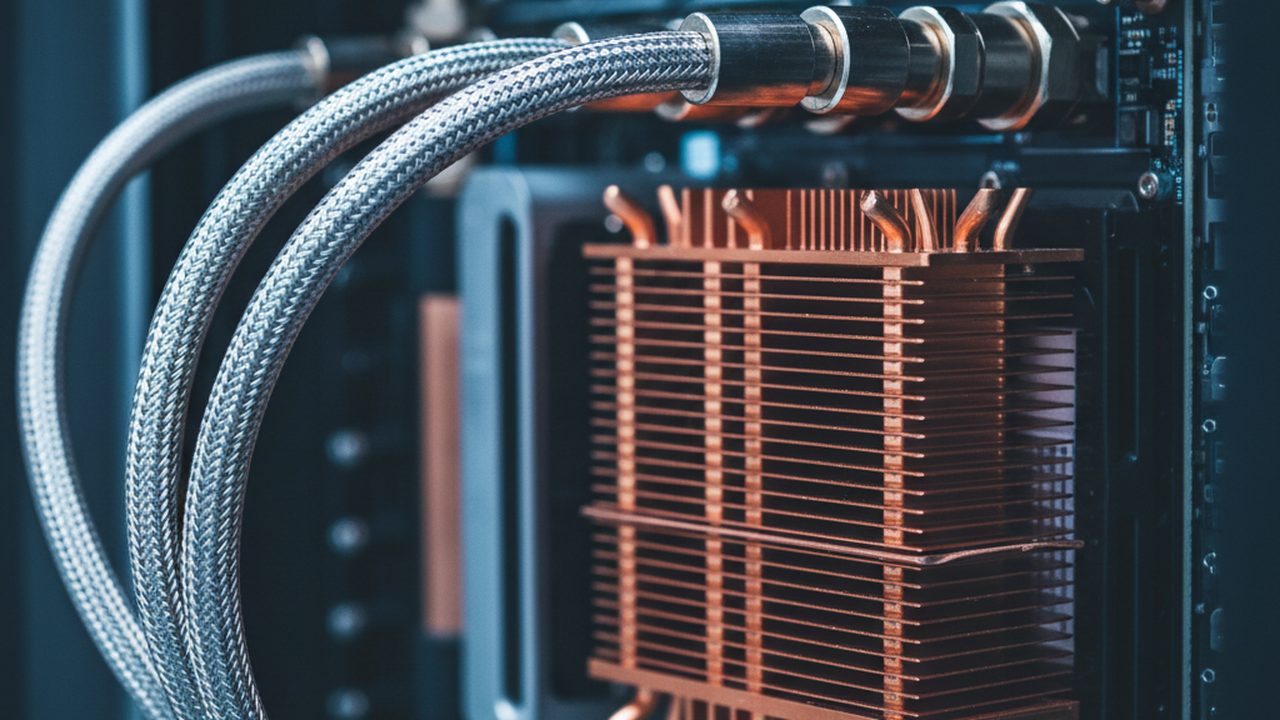
As air cooling reaches its practical limits, the industry is shifting toward liquid cooling. Water has a heat capacity roughly four times that of air and is much more efficient at transporting thermal energy away from concentrated sources. Most modern high-density data centres are now being designed or retrofitted for some form of liquid-to-chip cooling. This typically involves a closed-loop system where a cold plate—a copper block with internal micro-channels—is clamped directly to the processor.
In these systems, a coolant is pumped through the cold plate, absorbing the heat directly from the chip. The warmed fluid then travels to a heat exchanger, where the thermal energy is transferred to a secondary loop or dissipated into the outside environment. Because liquids are so much more effective at heat transfer, the processors can be kept at lower, more stable temperatures even under maximum load. This not only allows for higher performance but also reduces the energy wasted on leakage current.
- Direct-to-chip cooling uses cold plates to remove heat from the most intensive components while leaving some peripheral cooling to air.
- Immersion cooling involves submerging the entire server in a non-conductive, dielectric fluid, which eliminates the need for fans and heat sinks entirely.
The transition to liquid cooling is not merely a change in hardware; it represents a fundamental shift in data centre architecture. Piping must be routed to every rack, and the risk of leaks must be managed through redundant sensors and specialized connectors. While the initial capital expenditure is higher, the operational efficiency gains are substantial. By removing the need for massive, energy-hungry fan arrays and allowing the facility to operate with higher ambient temperatures in the primary cooling loop, operators can significantly improve their Power Usage Effectiveness (PUE)—a metric representing the ratio of total energy used by the facility to the energy used by the computing equipment.
The industry is currently divided on the best implementation of these systems. Some favour a hybrid approach, using water for the GPUs and air for the rest of the server components. Others are moving toward full immersion, which offers the highest theoretical efficiency but complicates maintenance, as technicians must lift heavy, fluid-soaked equipment out of vats for repair. The choice often depends on the specific utilization patterns of the data centre. A facility dedicated to training large models, which runs at near-maximum capacity twenty-four hours a day, has a much stronger incentive to adopt aggressive liquid cooling than a general-purpose cloud facility with more variable workloads.
The move to liquid also enables better heat recovery. The "waste" heat from a water-cooled data centre is higher in temperature and more concentrated than that from an air-cooled one. This makes it more practical to repurpose that energy for district heating or industrial processes. Instead of simply venting energy into the atmosphere, the data centre becomes a source of thermal energy for the surrounding community, though the infrastructure to capture and distribute this heat remains rare and expensive to implement.
The pressure to adopt these technologies is being driven by the relentless increase in chip power. As the next generation of accelerators approaches the one-kilowatt mark per chip, the debate between air and liquid cooling is effectively over; liquid is no longer an optional upgrade but a functional requirement. The engineering focus has now turned to the reliability of these fluid systems over years of continuous operation, as a single failed pump or a blocked micro-channel could now lead to the immediate thermal failure of a multi-million-pound server rack.
Efficiency and the cost of idle hardware
A common misconception regarding the energy footprint of artificial intelligence is that electricity consumption scales linearly with the complexity of the task. In practice, the baseline power draw of a modern data centre is remarkably high, regardless of whether the chips are actively processing a request. This is largely due to the power requirements of the interconnect fabric, the memory systems, and the leakage current inherent in high-performance silicon.
Modern AI training clusters are composed of thousands of discrete processing units connected by high-speed networking cables. To maintain the low latency required for these chips to communicate, the networking switches and optical transceivers must remain powered and ready. Furthermore, the cooling systems must continue to circulate fluid or air to manage the heat generated by the idle state of the hardware. The power leakage in a non-active state can account for a significant portion of the total energy budget. While consumer electronics have become adept at aggressive power gating, where portions of a chip are effectively turned off when not in use, the accelerators used for large-scale model training are designed for maximum throughput. Implementing deep sleep states in these environments would introduce unacceptable latency when a new batch of data arrives for processing.
The utilisation rate of a data centre therefore becomes the primary metric for its carbon efficiency. If a facility draws fifty megawatts at full load but still requires twenty megawatts while idle, any period of inactivity represents a profound waste of resources. Large-scale providers attempt to mitigate this by stacking diverse workloads, using the gaps between training runs to perform less intensive inference tasks or data processing. However, as the hardware becomes more specialised for specific types of matrix multiplication, it becomes less efficient at these general-purpose tasks, creating a dilemma where the most powerful chips are also the most difficult to keep productive around the clock.
Local constraints of the transformer and substation
The electrical infrastructure required to support these facilities is reaching its physical limits at the local level. A typical warehouse-scale data centre once required roughly ten to twenty megawatts of power. Modern facilities designed for generative AI are now requesting hundreds of megawatts, sometimes approaching a gigawatt for a single campus. This concentration of demand places immense strain on the local distribution network, specifically at the substation level.
Substations serve as the interface between high-voltage transmission lines and the lower-voltage distribution lines that feed individual buildings. Stepping down this voltage is the job of the transformer, a device that relies on electromagnetic induction and is subject to its own thermal constraints. When a data centre suddenly increases its load, the resulting heat within the transformer can degrade its insulation, leading to equipment failure. Replacing a utility-scale transformer is not a simple matter of maintenance; these components are massive, expensive, and currently face global supply chain delays that can extend to two years or more.
The grid was designed for a predictable, distributed load. Homes and small businesses have peaks and troughs that tend to average out across a city. A data centre, by contrast, is a massive, concentrated point-load. It behaves less like a building and more like a heavy industrial furnace. In many urban hubs, such as London, Northern Virginia, or Dublin, the local substations have reached their thermal and electrical capacity. Consequently, new data centres are being told they must wait years for a connection, not because the country lacks electricity, but because the local pipes are too small to deliver it to their specific doorstep.
Transmission bottlenecks and the interconnection queue
Beyond the local substation lies the high-voltage transmission network, the long-distance backbone of the power grid. The primary challenge here is the mismatch between where power is generated and where it is consumed. In many regions, renewable energy sources like wind and solar are located in remote areas or offshore, far from the metropolitan areas where data centres are traditionally built. Moving that energy requires high-voltage lines that are difficult to permit and slow to construct.
The physical capacity of the transmission grid is becoming a primary constraint on the geographic expansion of computational infrastructure.
This has resulted in a backlog known as the interconnection queue. In the United Kingdom and the United States, thousands of gigawatts of new capacity, much of it renewable, are waiting for permission to connect to the grid. Data centres are stuck in the same queue. Because the grid must maintain a precise balance between supply and demand to avoid frequency fluctuations and blackouts, grid operators cannot simply allow every new facility to plug in. They must conduct rigorous studies to ensure that adding a new three-hundred-megawatt load will not destabilise the network hundreds of miles away.
The queue is not merely a bureaucratic hurdle but a reflection of a fundamental physical reality. The current grid was built for a centralised model of fossil fuel power plants located near population centres. The shift toward decentralised renewables and massive, concentrated data loads requires a total architectural overhaul of the transmission system. Until this happens, the lead time for a new high-power facility is often dictated by the schedule of grid upgrades rather than the speed of building construction.
Strategies for behind-the-meter power generation
Frustrated by these delays, some technology companies are attempting to bypass the grid entirely through behind-the-meter power generation. This involves building a dedicated power source on the same site as the data centre, allowing it to operate independently of the public utility. Initially, this took the form of massive arrays of diesel or gas generators, intended only for emergency backup. Now, these systems are being designed for continuous operation.
Natural gas turbines are a common choice for these on-site plants because they can be deployed more quickly than a full grid connection. While this allows a data centre to become operational sooner, it often conflicts with the environmental goals publicly stated by the operators. To resolve this, there is growing interest in small modular reactors and hydrogen fuel cells. These technologies promise a steady, carbon-free source of baseload power that does not depend on weather conditions or the stability of the external grid.
However, on-site generation introduces its own complexities. A data centre operator essentially becomes a small utility company, responsible for fuel procurement, waste management, and the maintenance of complex power plant equipment. There are also significant regulatory hurdles; in many jurisdictions, generating your own power at this scale requires a complex set of permits and may still involve fees to the local utility to maintain a standby connection. The transition from being a consumer of power to a producer of power is a radical shift in the business model of the technology industry, driven by the necessity of physical proximity to the source of electrons.
Physical boundaries of the computational expansion
The scaling of artificial intelligence is currently hitting a wall composed of copper, steel, and land. While the theoretical limits of silicon are still being pushed, the practical limits are defined by how much heat can be moved and how much electricity can be delivered to a single coordinate on a map. We are seeing a shift away from the traditional data centre hubs toward more remote locations where land is cheap and power is abundant, such as the Nordics or the rural American Midwest.
It is now established that the energy intensity of AI training is orders of magnitude higher than conventional cloud computing. It is also clear that current grid infrastructure in most developed nations is insufficient to support the projected growth of these systems without multi-billion-pound investments and decades of construction. What remains contested is whether the efficiency gains in software and hardware can outpace the growing demand for larger models. Some researchers argue that algorithmic breakthroughs will eventually reduce the need for massive compute clusters, while others maintain that the scaling laws of large language models show no signs of diminishing returns, meaning the demand for power will only continue to accelerate.
The picture would change significantly if a new form of memory or processing emerged that operated at much lower voltages, such as optical computing or advanced neuromorphic chips. These technologies exist in laboratory settings but are not yet ready for mass production. Alternatively, a breakthrough in long-distance energy transmission, such as high-temperature superconductors, could decouple the location of the data centre from the constraints of the local grid. Until such shifts occur, the expansion of artificial intelligence will remain a problem of civil engineering and thermodynamics as much as one of computer science.